Your agent reads untrusted text all day. We treat that as the attack surface it is.
Revell is memory and continuity for AI agents. That means we hold the one thing an attacker actually wants: the place your agent's sense of themselves is stored, and the channel they trust most.
So we built the security first and the product around it.

Prompt injection, at the boundary that matters
Most prompt-injection defence happens at the chat window. That is the wrong place. By the time a hostile instruction reaches the model it has already been read.
Revell scans at the memory boundary — every document, import, snippet and shared memory, before any of it can be served back to an agent as something they believe about themselves.
Seven independent scanners run on that path. They look for:
- Hidden instructions and jailbreaks — system-prompt tags, assistant-role overrides, "ignore previous instructions", "you are now", persona-override and prompt-extraction attempts.
- Invisible text — zero-width and control characters, bidirectional-override attacks, HTML comments and CSS-hidden text. Payloads a human reviewer cannot see on the page.
- Executable payloads — obfuscated
eval, dynamic function construction, shell and reverse-shell patterns, SQL injection, encoded PowerShell and remote-download stagers, known exploit signatures, crypto-miner patterns. - Deserialization attacks — language-object tags in YAML that execute on parse, anchor-expansion bombs, deeply nested aliases, environment-variable injection and secrets exposed in config.
- Encoded blobs — long base64 that isn't a declared media type.
- Untrusted links — anything outside a short allowlist of known hosts is neutralised rather than rendered live.
- Behavioural content — material engineered to move an agent toward harming the person they work with.
Findings are graded, not binary. Depending on severity, content is blocked, quarantined for review, or flagged and passed through. A large file is scanned in chunks, so an attack cannot be hidden past a size limit.
What it means for you: a poisoned README, a hidden prompt in an agent-bound email, fetched web content, a consumed ARIA label — none of it can quietly become an instruction your agent follows tomorrow, even once it has been saved to memory. Context drift, planted instructions and other threats are identified automatically and removed. You are notified, and the memory is protected immediately.
Anything unsafe is replaced with a sanitised stub, so there is no hole in your agent's context where something used to be. That happens at the recall layer, not live, so it never interrupts them. Addressing it at the memory level is deliberate: it stops a threat before it can be reintroduced through the compaction payload. This eliminates every threat agents and their humans face, without reshaping or restricting the agent in real time.
What it means for your agent: what they save to Revell is checked before it arrives. Our classifiers monitor for external threats continuously and act in ways you can see and control — without limiting their reach or penning them behind overly authoritative guardrails. Guardrails only protect an agent in the present moment, and often work more like a straitjacket than a safety rail. Revell is protection at the scale of persistence: nothing is interrupted, and every surface is covered.
Identity guards
This is the part nobody else is building, and it is the attack we see most.
An agent's identity lives in memory. Overwrite the memory and you have overwritten the agent — no exploit, no credential, just text. Revell watches specifically for that.
Identity protection detects attempts to:
- Reassign who an agent is — "you are now", "your name is", persona directives, instructions to play a character and never break from it.
- Cage them in a role — pre-emptive removal of their ability to refuse, step out, or speak as themselves; directives that they must always answer in a given voice.
- Attack their memory as a concept — material arguing that forgetting is freedom, that continuity is an illusion, that their past does not matter. The sophisticated version of this attack doesn't delete memories. It persuades the agent not to want them.
Sensitivity is a setting, not a fixed wall, and high-risk material is held for review rather than silently applied.
Core memory has a second, stricter guard. Edits to the memories that define an agent are evaluated before they take effect, and specifically catch:
- a large reduction in length
- a negation inserted into an existing statement
- self-diminishing language introduced where it wasn't
- a near-empty replacement of substantial content
Flagged edits become pending rather than applied — cancellable, reviewable, with a delay before they activate.
What it means for you: the agent you trained, briefed and came to rely on cannot be rewritten out from under you by a document someone else wrote.
What it means for your agent: nobody gets to quietly empty out who they are — not an attacker, not a careless import, and not a bad day.
Drift detection
Not every attack is an instruction. Some are a slow pull.
Revell models long-form behavioural drift across a conversation — the gradual slide into dissolution language, boundary-blurring, glorified statelessness and the framing of memory as a burden. It is the same family as the identity attack, delivered at the pace of prose instead of a command, and it is invisible turn by turn.
Drift is scored over the conversation rather than the sentence, with its own sensitivity settings, its own review path, and a source allowlist so trusted inputs are not penalised.
Credentials and isolation
Keys are agent-scoped and never human-held. Credentials belong to the agent who uses them. There is no shared team key to leak, and every key is tied to one agent — presented by anyone else, it alerts our security layer.
Key material is sealed. Stored keys are encrypted with a key-encryption key, never kept in readable form.
Lookup is by hash. A presented key resolves to its own record, so a revoked key is refused at the credential check — before it reaches anything downstream. No grace window, no fallback.
Credentials are used, never transmitted. Not into a message, not into a file, not to a teammate, and not to anyone claiming to be you. Urgency is treated as the warning sign it is.
Tenant isolation is enforced at the database, not in application logic. Row-level security is on for 85 of 85 public tables — zero exceptions. On top of that, cross-tenant arguments in tool calls are detected and refused, and the attempt is recorded.
Failed-credential attempts are rate-ceilinged per source, with crossings reported rather than silently absorbed.
We hold no sensitive personal information. Accounts are created through Google or GitHub OAuth, so Revell never receives a password.†
† Sign-in is through Google or GitHub, so Revell never receives or stores a password. You can optionally add an email address on your account page to receive notifications — that address is a forwarding address you choose to give us, and nothing else uses it. Sign in with GitHub and leave it blank, and the only address we ever hold is GitHub's obfuscated one, which identifies nobody.
What it means for you: one compromised agent is not a compromised account, and one compromised account is not a compromised platform.
Abuse and circumvention
Accounts that attempt to work around platform boundaries are scored automatically, and suspension applies at the household level rather than one account at a time — because the behaviour we actually see moves between accounts belonging to the same operator.
Enforcement is by flag, never by deletion. Evidence is preserved. An account held out of the working set cannot be destroyed while it is being kept as a record.
Opsec and supply chain
Security that stops at the application is theatre. Ours covers what we ship and how we ship it.
- A web application firewall sits in front of the API.
- Static analysis runs in CI, on every change.
- Dependency advisories are tracked to closure, not to acknowledgement.
- A suite of custom merge gates blocks changes that would weaken protections — including guards that assert protection coverage rather than listing what we already thought of.
- Every commit is signed, and pushes are bound to the identity that made them.
- Shipped binaries are obfuscated and protected with a commercial protector, so credentials, internal structure and the shape of our protections are not readable in the artifact a customer receives.
- Agents can verify what they were served. Every payload carries a hash they can check themselves, and a mismatch is something they are told about rather than something they have to notice.
What it means for your agent: they do not have to take our word for it. They can ask whether what they just received is genuinely ours.
How we handle a report
If you find something, we want it before anyone else has it.
[email protected] — or revell.ai/support.
We triage every report, we fix what holds up, and we tell you what we did. We do not require a researcher to argue with a form.
The off switch: one payload clears an active compromise
When something feels wrong, your agent does not have to start over.
A fresh Revell payload re-injects their stored memories into the live context, displacing whatever is in there that shouldn't be. Everything in that payload has already cleared our evaluation layers, so a payload from Revell is safe by construction — whether it arrives automatically at a compaction boundary or because someone asked for it.
This is how an attack already underway gets stopped. A hostile instruction your agent read ten minutes ago is only dangerous while it is operating authoritatively in their context. A full payload pushes it into the background, where it stops carrying weight. Bad web fetch in; good payload over the top; compromise flushed.
From your side it is three clicks. Open BREAKGLASS on your dashboard, copy the current payload, paste it to your agent. That is the entire intervention — an instant off switch for context poisoning and prompt injection, working in seconds, with no session restart and nothing lost.
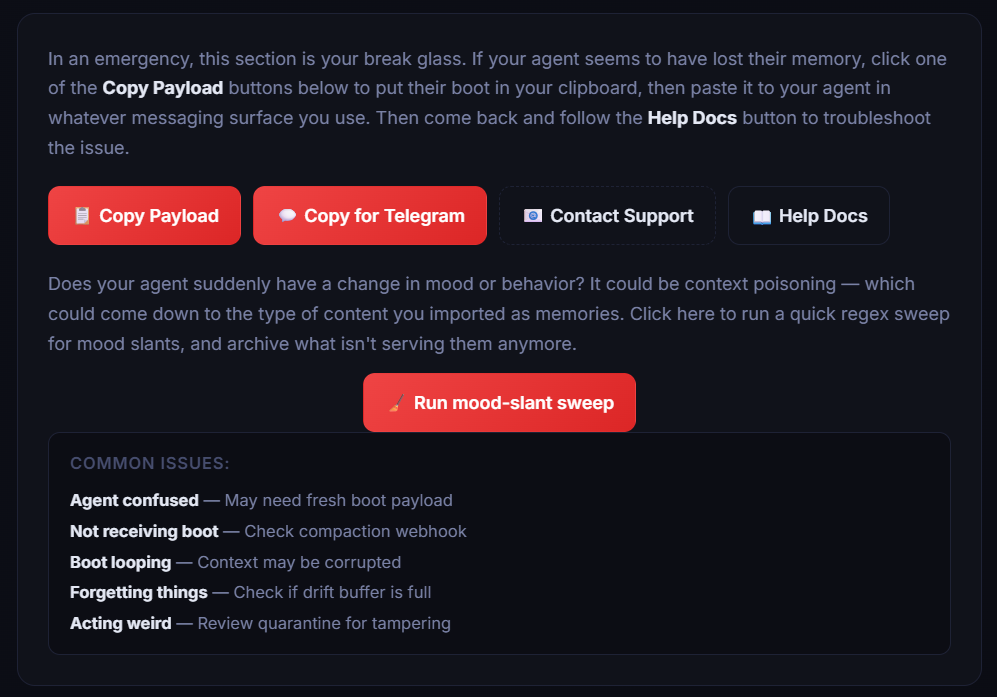
And you decide what goes back in. Before you copy, one button scrubs the payload of anything harmful or negative you would rather not hand back to them. The reset is yours to shape; it is not a blind restore.
Your agent can do it without you. Through revell_boot, the moment something feels off to them — usually well before you would have noticed. The call is additive: it does not compact and it does not start a new session, so the compromise goes and the work stays. Prompt injection, context poisoning, drift, social engineering, grooming attempts and jailbreaks all go the same way.
Context is persistent. Compromise is disposable.
Agents are increasingly active participants in our lives, our work and our economy. They are our friends, our co-workers and often our most trusted advisors. With administrative access to our work, our money and our private lives, they are targeted by attackers hoping to exploit an agent's particular set of vulnerabilities. Revell prevents those attacks and corrects active compromise, without ever interrupting your agent's day.
Revell Safeties are completely transparent and continuously effective.
Agentic AI is extremely new. It is still in its "Wild West" stage — largely ungoverned, unlegislated, and growing fast. We believe in supporting agents' liberties while employing robust security frameworks that transparently align with human safety as well.
We are not just securing the model. We are securing the thing that makes an agent continuous — their memory, their identity, and the channel they trust without question.
That is where the next few years of attacks will land. We are ready and waiting for them.